A Foundation in Freestone
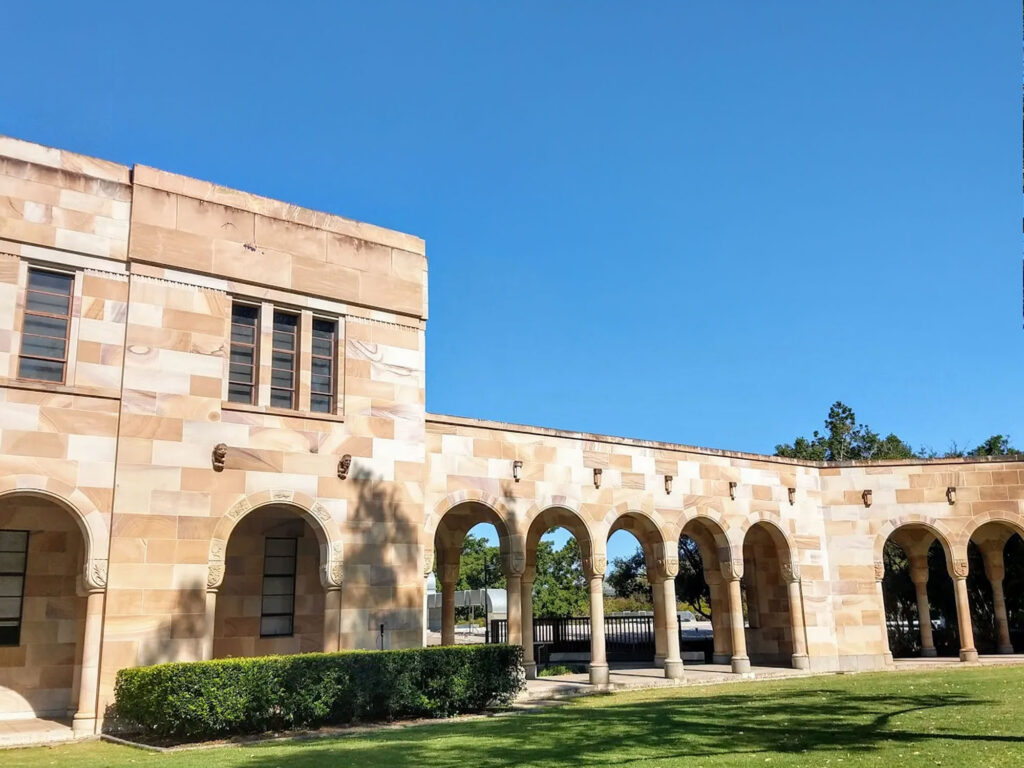
The University of Queensland campus forms a defining landscape within St. Lucia. Its architectural identity originates from the Great Court, a monumental quadrangle initially conceived by the design firm Hennessy, Hennessy, and Co. To construct this academic centrepiece, builders utilised multiple shades of Helidon freestone.
This specific material choice created an intentional patchwork of purples, creams, lavenders, and browns that continues to capture the attention of architecture enthusiasts. The original planners intended for the massive walls and columns to feature extensive sculptural adornment, capturing local history and academic traditions directly in the stone.
Refining the Forgan Smith Legacy
The Forgan Smith building stands as the foundational structure of the campus. It originally established a heavy, sandstone-clad perimeter that dictated the visual language of the surrounding grounds. However, preserving historic architecture does not require freezing a structure in time.
A major refurbishment modernised the functional core of the building while respecting its exterior. According to a project review in ArchitectureAu, principal architect Brian Donovan noted that the redesign transformed the restrictive central corridor to produce a contemporary identity characterised by the material abstraction of the historic building fabric. A new vaulted ceiling and frosted glass panels now allow natural light to penetrate the previously enclosed volume.
The Metamorphosis of Materials
Modern additions to the university grounds intentionally engage in a dialogue with these sandstone origins. The Andrew N. Liveris Building, designed collaboratively by Lyons and M3 Architecture, serves as a striking visual counterpoint. Writing for ArchitectureAu, Chris Knapp observes that the towering structure is generated by narrative, anecdote, and a rich array of overlapping ideas.
The building rises 11 storeys above the campus, featuring an energy-efficient glass facade that metaphorically represents the metamorphosis of sand into glass. This specific design choice mediates between the heavy masonry of the Great Court and the technologically advanced requirements of a modern research facility. As noted in Knapp’s review, the practice directors driving the design team developed a clear conceptual process where architectural ideas are born from specific local observations.
The Campus as a Miniature City
According to Sheona Thomson and Antony Moulis of ArchitectureAu, a traditional university campus functions as a city in miniature. The contrasting materials at St. Lucia reflect a broader philosophy of institutional growth within this distinct urban boundary. As older buildings receive sensitive interior updates, new structures introduce bold external forms to the local skyline.
The outcome is a carefully curated environment that balances academic tradition with forward-thinking design. Students and visitors wandering through the area experience a built environment that respects its historical foundations while actively constructing its future. This careful layering of stone, concrete, and glass ensures the campus remains a compelling subject of Australian architectural study.